
Hazing and rape culture are more connected than we think
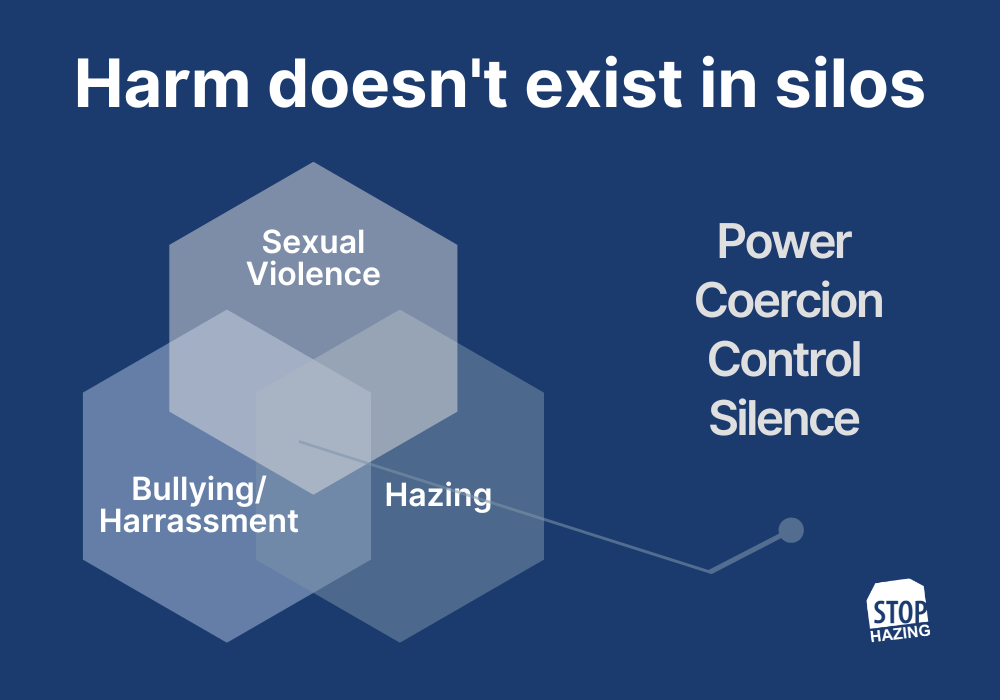
When the abuse of power makes national headlines, we respond by assigning the incident a category:
Hazing.
Sexual assault.
Harassment.
Bullying.
Abuse.
We name the behavior, identify the policy that may have been violated, and ask how to prevent it from happening again. Those questions matter. But they are not enough.
The work of prevention begins when we stop asking only “Which kind of harm occurred?,” and start asking “What conditions of power made that harm possible?”
Hazing, sexual violence, bullying, harassment, and other forms of abuse do not exist in silos. They intersect through systems of power, coercion, and control. Prevention requires us to see those connections.
Recent allegations of sexual assault and rape connected to a Cornell University fraternity have brought renewed national attention to questions about consent, gender dynamics, fraternity culture, institutional response, and accountability.
Alongside the Cornell case, this fall has seen a surge in hazing cases. Recent headlines have involved physical injury, forced consumption, humiliation, threats, and other forms of coercion.
Too often, we treat these as separate problems. But what if they are all connected at their core?
For decades, research on hazing has shown that hazing is not just a few individuals making bad decisions. It is a complex social phenomenon shaped by group norms, power, belonging, organizational culture, and institutional attitudes and culture. The same is true of sexual violence.
We know that consent is not meaningful when it is obtained through pressure, threats, manipulation, or coercion. People experience violence within social and institutional contexts, not in a vacuum. Current scholarship on campus sexual violence continues to point toward power, structural inequality, and intersectionality as essential to understanding prevention.
So what happens when we see hazing and sexual violence as intersecting issues? What we find is that hazing and sexual violence are fueled by overlapping conditions of power.
We need a more connected approach to prevention
If hazing intersects with sexual violence through power, coercion, and control, then our prevention efforts should reflect that.
Hazing prevention should include conversations about consent. Sexual violence prevention should include conversations about group norms and power. Bystander intervention should address situations in which people witness coercion before it escalates. Institutions should examine whether their policies, reporting systems, and organizational practices make it possible for people to safely challenge harmful behavior.
Prevention means seeing the pattern before the crisis. Hazing is addressed after someone is seriously injured, traumatized, or killed. Sexual violence is addressed after a life-changing assault. But prevention demands that we respond before the crisis:
What are the warning signs?
What beliefs are being normalized?
What power dynamics are emerging?
Who is encouraged to stay silent?
What behaviors are dismissed as tradition?
What happens when someone says no?
What happens when someone asks for help?
The goal of hazing prevention is not simply to remove harmful activities from an initiation process. It is to transform what belonging means. We can build groups where boundaries are respected rather than tested, and we can build campuses where prevention is not a collection of disconnected programs responding to disconnected problems, but a coordinated effort to address the conditions that allow harm to occur.
The work of prevention begins when we stop asking only “Which kind of harm occurred?,” and start asking “What conditions of power made that harm possible?”
Seeing that connection is essential for the transformation we need to respond effectively after harm occurs – and to create communities where that harm is less likely to occur in the first place.