
2025 Year in Review

As we reflect on 2025, one word rises to the surface: momentum. The year marked significant forward movement in research, education, transparency, and advocacy — propelled by campuses, families, partners, and prevention leaders who refuse to accept hazing as inevitable. Together, we expanded what’s possible, built new tools and infrastructure, and strengthened a shared commitment to protecting students nationwide.
From advancing the implementation of the Stop Campus Hazing Act, broadening the reach of research-based training and transparency initiatives, to shaping the national conversation through research and public outreach, StopHazing continued to meet the moment with expertise, innovation, and collaboration.
Thank you for being part of this work — for learning with us, challenging the status quo, and advocating for safer environments where students can grow, lead, and thrive. We’re proud to share the milestones that defined 2025 and excited to carry this momentum into the year ahead.
Below, we share highlights and updates from the past year across the many facets of our work.
Research and Scholarship
| StopHazing Peer-Reviewed Research Updates Throughout 2025, StopHazing researchers have contributed to the following seven peer-reviewed publications: Allan, E. J., Kerschner, D., & Franklin, D. (2025). Exploring the perceived impact of a multi-year campus hazing prevention initiative at eight universities. Journal of Interpersonal Violence, 40(23-24), 5818-5840. https://doi.org/10.1177/0886260524130829 Allan, E. J., Stewart, K., & Kerschner, D. (2025). What does it take? Reframing organizational commitment to campus hazing prevention. Journal of Student Affairs Research and Practice, 62(1), 26-41. https://doi.org/10.1080/19496591.2024.2393086 Berry-Cabán, C. S., Allan, E. J., Metzger, E. C., Roby, A., Holland, A., Reynolds, A., Nash, N. & Orchowski, L. M. (2025). A review of hazing prevention efforts in the United States military. Journal of Social Science Studies, 12(2). https://doi.org/10.5296/jsss.v12i2.23355 Franklin, D., & Allan, E. J. (2025). Examining factors perceived to enable and deter student reports of hazing. Journal of American College Health, 1–9. https://doi.org/10.1080/07448481.2025.2547797 Gillon, K. E., Allan, E. J., Beatty, C. C., Salinas, C., & Kerschner, D. J. (2025). Troubling Rigor: Exploring Intersections of Campus Hazing and White Supremacy. Innovative Higher Education, 50(2), 439-460. https://doi.org/10.1007/s10755-024-09737-1 Kerschner, D., & Allan, E. J. (2025). Student and varsity athlete hazing at NCAA Division III institutions: Predictive factors and implications for prevention. Journal of Higher Education, Athletics, Labor & Innovation, 1(2), 85–117. https://doi.org/10.15763/issn.3065-7369.2025.1.2.85-117 Kerschner, D., & Allan, E. (2025). We don’t haze: Testing the impact of a video-based hazing prevention training with college students. Journal of Interpersonal Violence, 40(3-4), 928-954. https://doi.org/10.1177/08862605241254140 |
Beyond these peer-reviewed manuscripts, 2025 was an important year spent preparing for an impactful 2026 and beyond for the StopHazing research team and the Hazing Prevention Research Lab at the University of Maine. In 2025, we continued to work to relaunch and expand the National Study of College Student Hazing, conducting pilot data collection throughout Fall 2025 ahead of our Spring 2026 launch.
Further, we evaluated the impact of hazing prevention trainings—including 10 Signs of Healthy and Unhealthy Groups and StandUp to Hazing—with diverse college student audiences. More than 2,000 students participated across these research studies. We also continued our evaluation efforts of the Hazing Prevention Consortium.
In 2026, the StopHazing research team is excited to continue to work to share the findings of these studies at conferences, in peer-reviewed journals, in webinars, and in practitioner-focused blogs (such as our previous Research-to-Practice Series), along with research findings related to the Spectrum of Hazing and social norms and hazing prevention, amongst other topics.
The priority research project of 2026 is the National Study of Student Hazing – this study will shape the prevention work of the field for years to come.
Hazing Prevention Consortium (HPC)
In 2025, HPC institutions made significant progress in shifting the culture of hazing on their campuses, as highlighted in this blog post. Achievements included broadening the scope of education offered to undergraduate students using strategies like the 10 Signs of Healthy and Unhealthy Groups training and the StandUp to Hazing™ online module. Other strategies included strengthening dedicated hazing prevention websites and campuswide policies, and making the collection of campus hazing data a routine part of annual surveys. Additionally, 2025 saw the launch of HPC Cohort 8 (Dartmouth College, Rutgers University – New Brunswick, Washington State University), who are making steady progress in strengthening capacity and commitment for hazing prevention at each of their campuses.
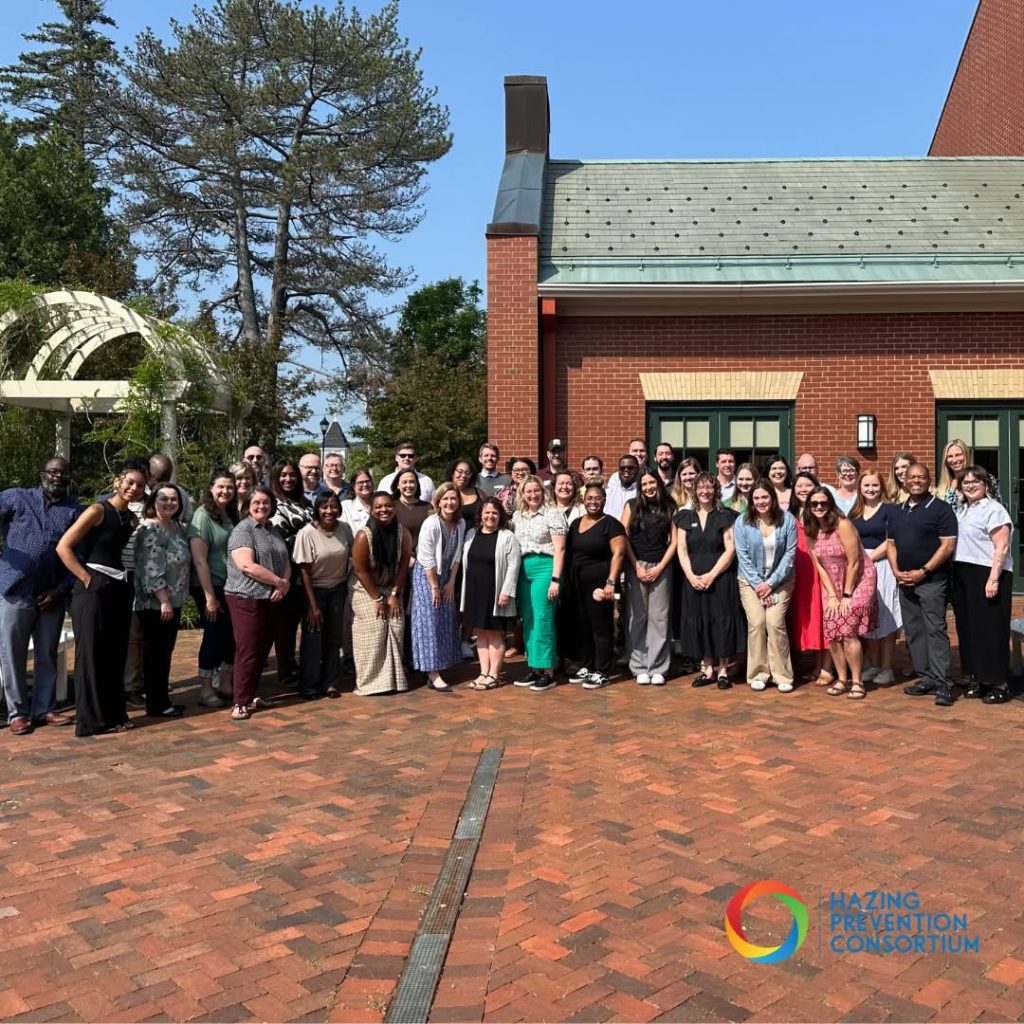
The 2025 HPC Summit– a 3-day gathering of HPC liaisons in Orono, ME. –saw record attendance (32 campus professionals from 14 institutions), and attendees engaged in dialogues about their campus’s approach to hazing prevention and gained insight on new tools and research coming from StopHazing. Cross-cohort conversations were a key component of this year’s Summit, and three HPC Mentors (liaisons whose institutions were previously involved in the HPC) presented on their institutions’ continued educational efforts and prevention programming while supporting those who are currently in the consortium.
We want to offer special thanks to Tanya Purdy (Brown University), Dr. Laura Santacrose (Cornell University/StopHazing), and Dr. Germayne Graham (University of Central Florida) for their mentorship and time offered to make the Summit a success.
Finally, the continued researcher-practitioner partnerships of the HPC led to the development of new StopHazing resources. Notably, insights gained from campus practitioners informed updates to the Hazing Transparency and Website Rubric and spurred the development of the Hazing Policy Development Rubric.
If your institution is interested in gaining access to exclusive HPC resources, we are now accepting applications for Cohort 9 and will launch in Fall 2026. Please reach out to meredith@stophazing.org for more information.


New Resources and Content
As the home to the most extensive collection of hazing prevention resources, StopHazing continued to build no-cost resources this year. We also shared hazing-prevention content on education, training, policy, and research through 23 new blog posts.
Alongside our blog posts, we introduced new content briefs, both packed with actionable insights, research-informed strategies, and topic-specific guidance to strengthen prevention efforts, foster positive group and team cultures, and promote safer, more inclusive communities.
New brief: Stop Campus Hazing Act Implementation: An Administrator’s Guide
NEW No-Cost Resources:
- Campus Hazing Policy Planning Tool (in collaboration with Clery Center)
- What is Hazing: Recognizing Hazing Flowchart
- Tabling Activities
- Hazing Prevention Tabling Activities: 10 Signs Edition
- Hazing Case Role-Playing Game
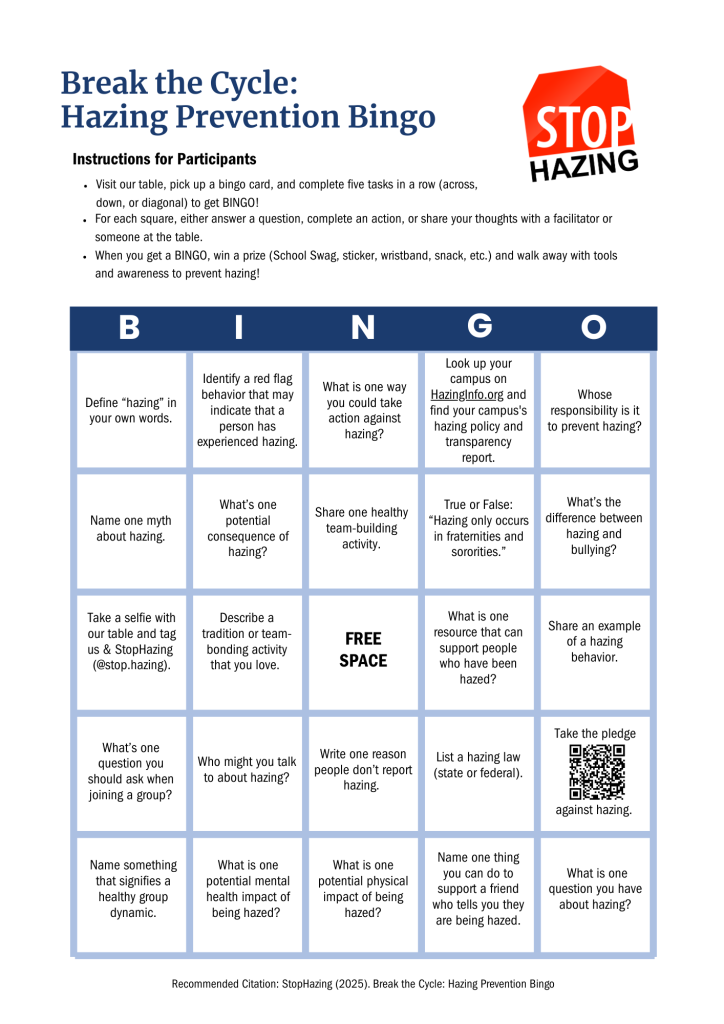
- Break the Cycle: Hazing Prevention Bingo
- Residence Life Resources
- Social Media Campaign and Guide
- Hazing Prevention Pledge
- HAZING Film Addenda
- Power Dynamics
- Mental Health and Hazing
- Bystander Intervention
Policy and Advocacy

As we celebrate the one-year anniversary of the Stop Campus Hazing Act (SCHA) as federal law, we reflect on a year of policy support and advocacy. In addition to our support of campuses through the HPC and annual Membership Programs, here is a snapshot of our support for implementation of the SCHA:
- Co-hosted a spring and fall three-part webinar series with Clery Center on educational requirements, reporting requirements, and best practices
- Offered expert guidance at conferences and summits (see more below)
- Policy implementation coaching calls with institutions participating in the HPC, Membership, and/or Policy & Prevention programs.
- Engaged with and had ongoing dialogue with policy makers, educators, and family members to build and refine best practices
Additionally, Dr. Allan authored or co-authored 7 op-eds in outlets across the country and 4 blog posts related to the SCHA.
StandUp to Hazing™ Online Course
StandUp to Hazing (SUP) has continued to be an impactful research-informed resource for campuses and national organizations. A few highlights this year include:
- Educating over 400,000 learners across the country
- Serving 4-year institutions, community colleges, and national organizations
- NEW faculty and staff course will be released in Spring 2026
- The evaluation data from SUP points to its effectiveness – a forthcoming study analysis will share more about this:
- 94% of students reported increased confidence in recognizing hazing.
- 94% of students felt they were more likely to know where and how to report hazing.
- 94% of students felt more likely to think of themselves as an active bystander who can make a difference to prevent hazing.
Membership and Consulting
Our Comprehensive Membership and Policy and Prevention Programs welcomed new and returning colleges and universities. Members received exclusive access to rubrics, consulting, and resources for best practices and compliance with the Stop Campus Hazing Act.
Our team also partnered with K-12 schools and organizations to offer train-the-trainer workshops to prepare their teams and staff to deliver impactful research-informed hazing prevention trainings..
These opportunities allow us to support campuses, regardless of resources or capacity, to level up their hazing prevention efforts with research-based tools and expert consulting. Interested in joining? Reach out to jenny@stophazing.org to learn more.
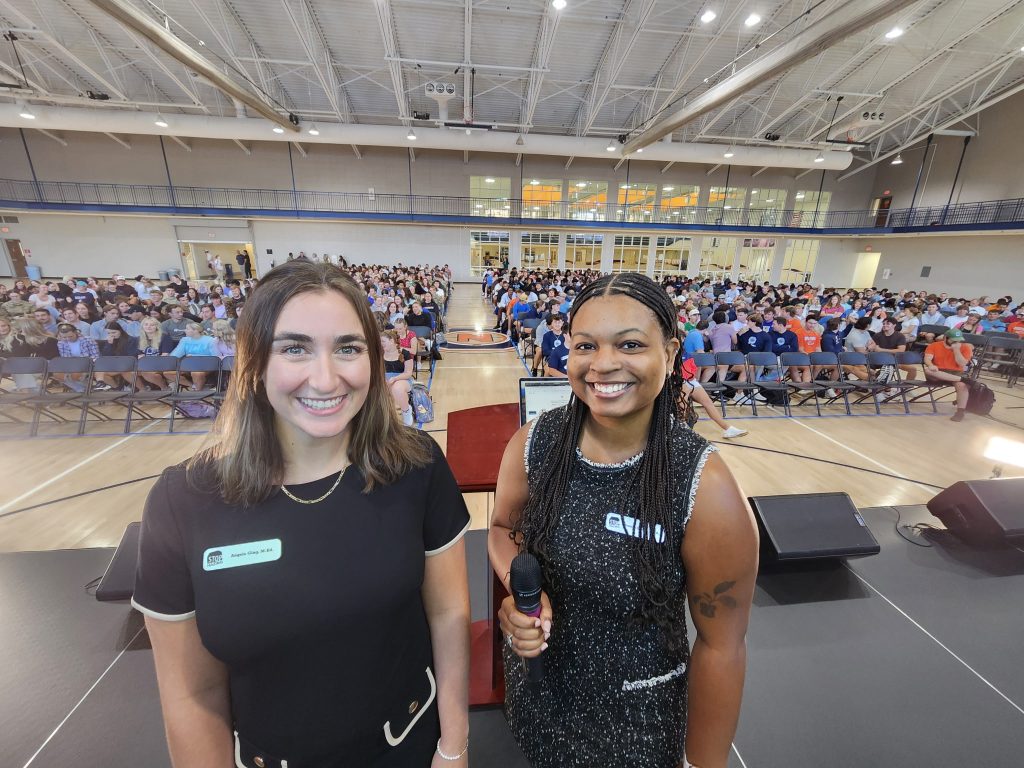
Programs and Trainings
This year, our facilitation team delivered workshops both virtually and in person, reaching campuses across the country and providing tailored, hands-on education to small and large groups. The most popular workshops were Making Space for Leaders to Lead Change and 10 Signs of Healthy and Unhealthy Groups.
A special thank you to our facilitators, Angela Ging, M.Ed., Lauren Griffin, M.Ed., Devin Franklin, M.Ed., and Sierra Medina for their dedication and expertise!
Workshops Hosted in 2025
- Ohio State University
- California State University- Los Angeles
- University of Alaska- Anchorage
- University of Nebraska- Kearney
- Carson-Newman University
- Saint Leo University
- McDaniel College
- Hobart and William Smith
- La Salle University
Partnerships, Projects, and Special Collaborations
In 2025, we strengthened existing relationships and forged new partnerships to bolster our collective work in hazing prevention. We highlight and thank the following partners for their generosity of time, resources, and thought partnership across this year:
- Hazing Prevention Research Lab – At the University of Maine, College of Education & Human Development, the research lab is leading the globe in hazing prevention research in partnership with StopHazing, including relaunching the National Study of Student Hazing.
- HazingInfo.org – A partnership between the University of Maine and the University of Washington’s Information School, and founders Jolayne Houtz and Hector Martinez. This database is bringing hazing out of the shadows and providing accurate information about hazing at all colleges and universities across the country.
- Catharsis Productions – Partners in the development of a new hazing prevention online education module, rooted in StopHazing’s research and expertise, developed with the signature Catharsis style and tone. Read more about the partnership here.
- Clery Center– In ongoing partnership with Clery Center to collaboratively develop and share research-based and research-informed hazing prevention education and provide training and resources for Stop Campus Hazing Act (federal law that amended the Clery Act) implementation.
- Byron Hurt and God Bless the Child Productions, LLC. – Building on our partnership with filmmaker Byron Hurt and his production company, God Bless the Child Productions, we partnered to host another film viewing and developed two additional discussion guide addenda focused on power dynamics and mental health to accompany Hurt’s (2022) film HAZING.
- University of Virginia’s Gordie Center– The Gordie Center supported the relaunch of the National Study of Student Hazing and will collaborate with StopHazing on the development of new hazing prevention resources for campus professionals with findings from the study. Read more about the partnership here.
Additionally, in 2025, StopHazing’s principal, Dr. Elizabeth Allan, was invited to speak on several podcasts and YouTube channels. We want to thank Dr. Gerald Reid and Alexis Reid of Reid Connect-ED podcast, Christopher Rudder of Cultured Unplugged, Dr. Laura De Veau of the Fac/Staff Lounge podcast, and Ron Lisnet of the Maine Question podcast.
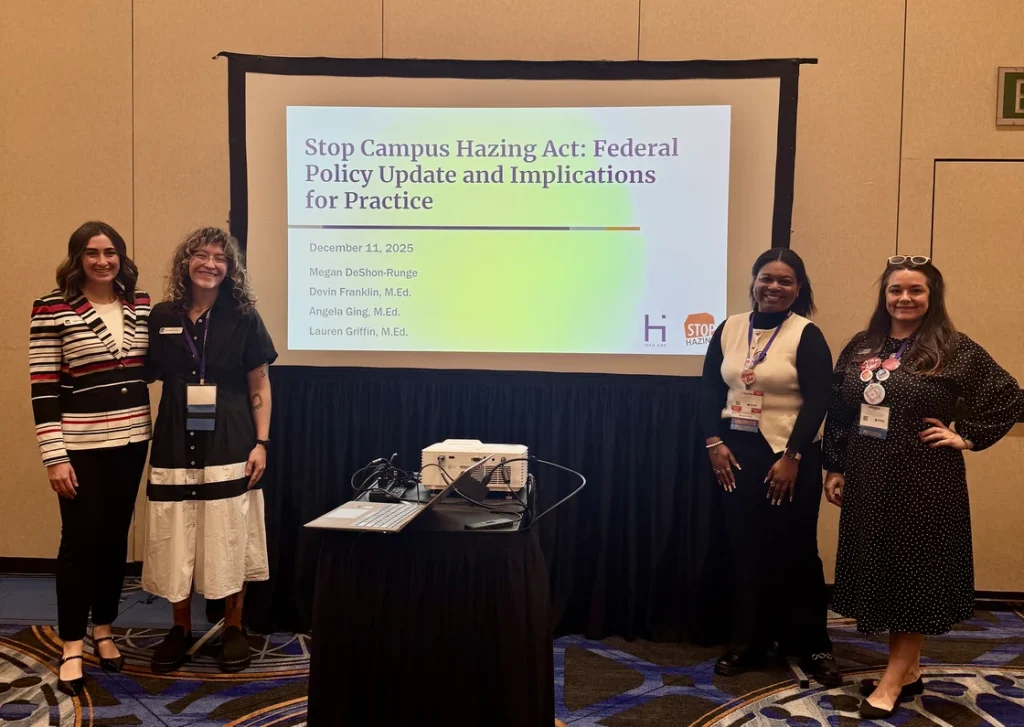
Conferences and Special Events
This year, StopHazing connected with campuses and professionals nationwide through presentations, summits, trainings, and conference engagement, including:
- Association of Fraternity and Sorority Advisors (AFA) Annual Meeting – Presented at an expert-facilitated roundtable, delivered a presentation, and exhibited at the Annual Meeting in Las Vegas.
- Pacific Northwest Anti-Hazing Summit – Presented an educational session.
- LaHEC Annual Professional Development Summit – Presented two educational sessions for a statewide higher education event in Louisiana.
- University of South Carolina Statewide Hazing Prevention Summit – Designed and facilitated a two-day summit focused on hazing prevention.
- Meeting of the Minds – Presented two educational sessions and exhibited at the conference in St. Louis, MO.
- University of California System Hazing Prevention Summit – Designed and facilitated a two-day system-wide summit on hazing prevention.
- NASPA Strategies Conference – Presented two half-day pre-conference sessions and two educational sessions in Boston, MA.
Alongside our conference engagement, StopHazing, in partnership with the Clery Center, led two 3-part training series designed to guide campuses in understanding and applying the Stop Campus Hazing Act.
National Hazing Awareness Week
Each year, in honor of the Congressionally designated National Hazing Awareness Week (NHAW), we hosted several events – and release expanded resources to better support campuses and organizations in preventing hazing.
This year, StopHazing partnered with the Media Education Foundation to offer free viewings of the award-winning film HAZING, along with new film companion resources focused on power and mental health. We also launched Residence Life resources for staff and RAs, as well as interactive tabling activities, including the 10 Signs Edition, a Hazing Case Roleplaying Game, and Break the Cycle: Hazing Prevention Bingo, to engage students and spark meaningful conversations. Additional tools included a ready-to-use social media campaign and the Hazing Prevention Pledge, encouraging individuals to commit to building safe and inclusive communities.
Awards and Recognition
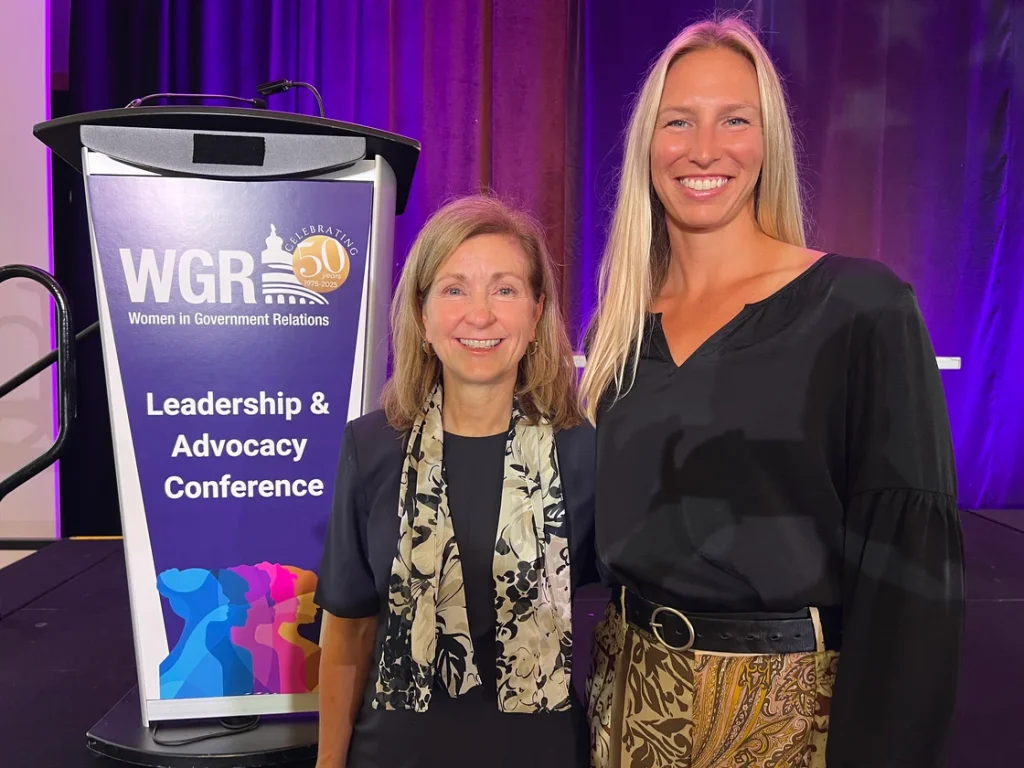
We were excited to receive national recognition as Meredith Stewart, MEd, Abby Boyer, MA, Jessica Mertz, and Dr. Elizabeth Allan were named finalists for Excellence in a Federal Issue Campaign at the 2025 Women in Government Relations Leadership & Advocacy Conference in Washington, D.C.!
Additionally, Dr. Elizabeth Allan received the NASPA Region I Outstanding Contribution to Literature and/or Research Award.

HazingInfo.org – Transparency Database
In 2025, HazingInfo.org continued to grow as a critical national transparency initiative, strengthening public access to reliable, centralized information about hazing policies, reporting practices, and prevention infrastructure across U.S. colleges and universities. Through expanded data collection, platform enhancements, and deeper engagement with families, HazingInfo reinforced the essential role transparency plays in preventing hazing and protecting students.
Expansion of States and Data
This year marked significant expansion of HazingInfo’s institutional coverage, with new states added and existing datasets strengthened after the deadline for the Stop Campus Hazing Act passed on December, 23, 2025. As more campuses were reviewed, the database became an increasingly comprehensive national resource—supporting students, families, journalists, researchers, and campus professionals seeking accurate information about hazing policies, reporting mechanisms, and institutional accountability.
Explore the database: https://www.hazinginfo.org/campus-lookup
Hazing Death Database
In 2025, HazingInfo continued to expand its Hazing Death Database, building on the work of Hank Nuwer, honoring lives lost while documenting the tragic consequences of hazing with care, accuracy, and responsibility. This resource serves both as a memorial and as a sobering educational tool, reinforcing why transparency, prevention, and accountability are non-negotiable.
View the database: https://www.hazinginfo.org/hazing-deaths
Enhancing Transparency Guidance for Colleges and Families
In 2025, HazingInfo strengthened its website to better support colleges, universities, and families in understanding how institutional transparency is assessed. New guidance clarifies what it means for an institution to earn all three green checkmarks—clear hazing policies, accessible reporting processes, and publicly listed incident reports along with prevention contacts. By clearly outlining expectations and requirements, HazingInfo helps institutions improve their practices while enabling families and students to more easily evaluate campus commitment to hazing prevention.
Learn how HazingInfo works: https://www.hazinginfo.org/how-we-work
Newsletter and Blog Growth
HazingInfo’s newsletter and blog continued to expand in reach and influence, offering timely updates, data insights, and explanatory content that contextualizes national trends. Through regular communication, HazingInfo helped audiences better understand what transparency looks like in practice—and why it matters.
Read the blog: https://hub.hazinginfo.org/blog
Sign up for updates: https://www.hazinginfo.org/newsletter
Family Partnerships and Impact Narratives
Families remained at the heart of HazingInfo’s work in 2025. Through partnerships and participation in the State of Hazing series, families shared their experiences, insights, and calls for accountability. These narratives brought critical human context to the data and reinforced the importance of centering lived experience alongside institutional information.
Read the final installment in the State of Hazing series, highlighting lessons learned:
https://hub.hazinginfo.org/blog/lessons_learned_state_of_hazing_america
The Role of Transparency in Prevention
Across all HazingInfo initiatives in 2025, one theme remained clear: transparency is prevention. By illuminating where policies exist, where reporting pathways are clear—or where gaps persist—HazingInfo empowers informed decision-making and drives institutional change. Making hazing visible is a necessary step toward ending it.
Learn more: https://www.hazinginfo.org/hazing-facts
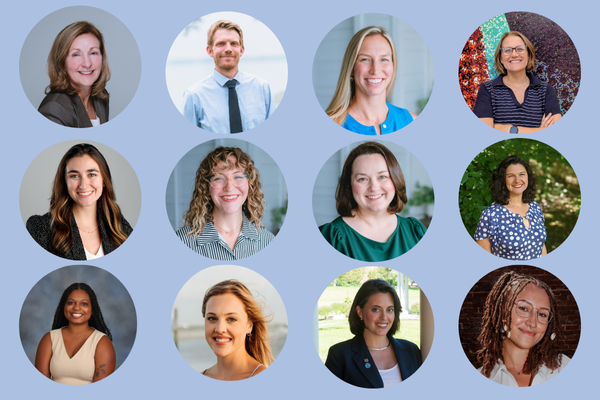
StopHazing Team
The StopHazing team continues to grow, bringing together professionals with a wide variety of skills, backgrounds, and experiences to strengthen and elevate our work. Each team member contributes exceptionally high-quality work, collaborates with care, and shares a deep commitment to preventing hazing and supporting safer learning communities.
Our team includes:
- Elizabeth J. Allan, Ph.D., Principal
- Dave Kerschner, Ph.D., Post-Doctoral Fellow for Research & Evaluation
- Meredith Stewart, M.Ed., Operations Manager
- Abby Boyer, M.S., Policy and Prevention Specialist
- Angela Ging, M.Ed., Training Specialist & Research Assistant
- Devin Franklin, M.Ed., Doctoral Research Fellow
- Jenny Desmond, M.A., Program & Training Specialist
- Laura Santacrose, DrPH, MPH, Research and Practice Consultant
- Lauren Griffin, M.Ed., Program and Prevention Coordinator
- Meg Stewart, M.P.A., Communications Assistant
- Paige Holmes, MBA, Chief Development Officer
- Sierra Medina, Communications and Outreach Specialist
New to the team this year are: Lauren, Sierra, Abby, Laura, and Paige!
We’re grateful to work alongside our talented interns, who bring fresh insight and dedication to our hazing prevention efforts.
Spring 2025 Interns
- Charlotte Allen – Allegheny College
- Lauren Griffin – University of North Texas (now staff)
- Jay Muszynsky – Indiana University
Summer 2025 Interns
- Olivia Adams – University of Maine
- Eunice Opare – University of Maine
- Josie Veilleux – University of Maine
Fall 2025 Interns
- Brant Barber – North Carolina Central University
- Olivia Henrique – University of Maine Law School
Interested in becoming a 2026 intern? Learn more about our opportunities here.
Media Features
Here are a few recent news headlines featuring StopHazing’s work:
- Hazing Prevention on College Campuses: Relationships Are Key to Reporting Incidents
- Landmark study of college hazing to get its first update in 17 years
- University requires anti-hazing course in campus email detailing ‘egregious’ 2023 hazing case
- Online database co-developed by the University of Maine sheds light on hazing across the US
- The Negative Impact of Hazing
StopHazing’s research, resources, and events were highlighted on CNN, FOX / ABC local news, Campus Safety Magazine, and other national and regional outlets throughout 2025.
Featured Op-eds / Spotlight Stories by StopHazing Staff or about StopHazing:
- Allan, E. J., & Dawson-Bernard, B. (2025, October 2). How awareness can empower us to eradicate hazing at Ole Miss. Daily Journal. https://www.djournal.com/opinion/columnists/how-awareness-can-empower-us-to-eradicate-hazing-at-ole-miss/article_4996abc4-b361-4ba2-a2ab-c7fd1b6f6195.html
- Allan, E., & Tully, R. (2025, September 25). Column: After tragic death, VCU leads the way on hazing prevention. The Virginian-Pilot. https://archive.is/EJLDh#selection-1459.4-1459.70
- Santulli, M.P., & Allan, E. (2025, September 25). Opinion: How ‘Danny’s Law’ is offering a path to safer campuses. St. Louis Post-Dispatch. https://archive.is/bo50f#selection-3099.13-3099.30
- Allan, E. (2025, September 23). Opinion: USD shows how colleges can work toward a hazing-free future. The San Diego Union-Tribune. https://archive.is/sk9ZR#selection-1779.4-1779.72
- Allan, E. (2025, August 18). Harrison’s Law: a big step towards ending hazing in NC. The Carolina Journal. https://www.carolinajournal.com/opinion/harrisons-law-a-big-step-towards-ending-hazing-in-nc/
- Hipps , C., & Allan, E. (2025, May 21). Commentary: New data show SC’s hazing problem is broader than you think. Post and Courier. https://www.postandcourier.com/opinion/commentary/sc-colleges-universities-hazing-tucker-hipps-act/article_eb2678c9-a8f2-4fde-9549-56f49794ebf3.html
- Allan, E. (2025, May 6). Westhill lacrosse incident a tragic reminder: Hazing is not a joke (guest opinion by Elizabeth Allan). Syracuse.com.https://www.syracuse.com/opinion/2025/05/westhill-lacrosse-incident-a-tragic-reminder-hazing-is-not-a-joke-guest-opinion-by-elizabeth-allan.html
In 2025, StopHazing was referenced in 50+ news articles and opinion pieces across national, regional, and campus media, reflecting the organization’s expanding influence in shaping public understanding of hazing and its prevention.
With Gratitude
Thank you for all of your hard work to prevent hazing this year – and, of course, for your support and for being a great colleague, friend, donor, advocate, and partner in preventing hazing and keeping students safe. 2025 was a big year. We made a lot of strides forward and have built momentum to launch into 2026 with more infrastructure, capacity, and determination to #StopHazing!
Thank you for everything.
With gratitude,
The StopHazing Team
Elizabeth, Dave, Meredith, Jenny, Devin, Meg, Lauren, Laura, Sierra, Abby, Paige, and Angela
Consider Giving to Life Saving Research
Your support has created vital momentum for hazing prevention research.
In 2025, our partner, the Hazing Prevention Research Lab at the University of Maine, unveiled the Lives Remembered, Futures Protected – Hazing Prevention Research Campaign. The goal is to raise funds to conduct the first national study on student hazing in almost twenty years and expand research to empower the whole hazing prevention community with research-backed prevention data and analysis.
Be part of the solution and give the life-saving gift of knowledge today. Please click here to make a meaningful, tax-deductible gift. We will keep you informed of our progress throughout 2026, and you will be among the first to learn of cutting-edge research.
To our supporters, including the Remember Nolan Project, the Gordie Center, the Hazing Prevention Research Lab Advancement Council & Ambassador Group, and the generous individual donors to this campaign – thank you. We are making 2026 the beginning of a crucial new trajectory in hazing prevention.